
Trying your first version
What to try after you've made your first AI demo
Getting a demo to work is exciting. The next step is trying it with someone else's real task, messy information and deadline so you can see what still needs work.
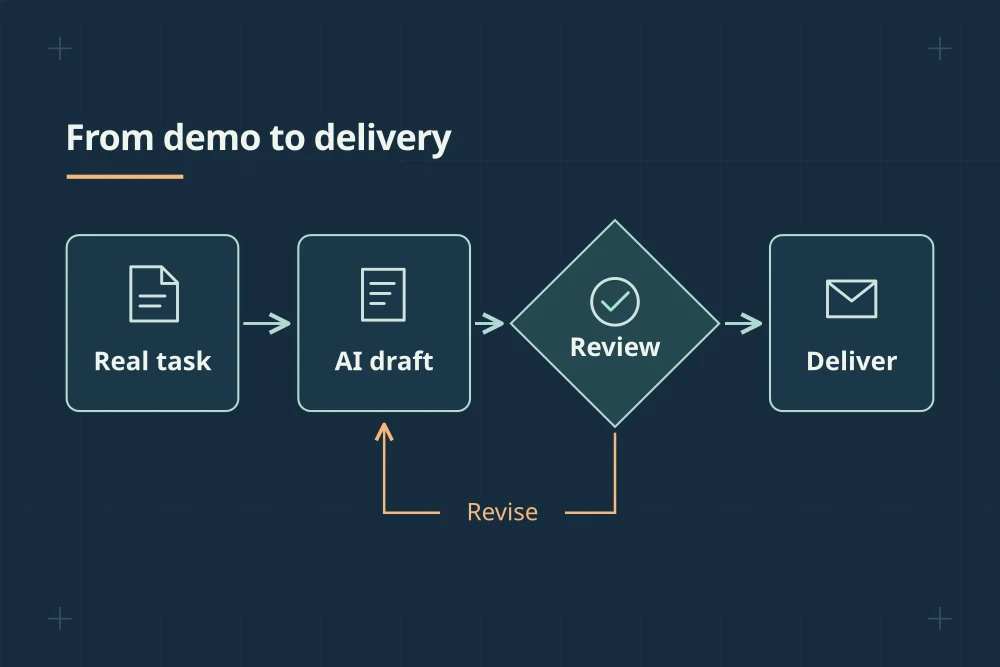
Watch someone use your idea from start to finish. Check whether they want the result, whether you can deliver it reliably and how much help it takes.
You've got a demo working, and it feels pretty good. You put in an example, the AI produces a sensible answer, and you can picture how someone might use it. Maybe you built it yourself, or maybe an AI tool helped you put it together over a few evenings.
It's tempting to spend the next week adding all the features you've thought of. Before you do, see if you can find someone with a real task to try it on. That will probably give you a more useful list of things to work on.
A customer brings plenty of things your demo may not have had to deal with yet. Their files might be incomplete, they may misunderstand an instruction, and someone else might have to approve the result. You need to learn how your idea fits into that whole job.
Write down what you still need to find out
There are a few questions worth separating because one successful test won't answer all of them. Does someone care enough about the problem to try your approach or pay for it? Can you produce the result they need using the information they actually have? And can you keep doing that without spending more time and money than the work earns?
A person signing up on a website gives you a reason to contact them, but you still don't know whether the tool will help them. A good result from your own test gives you confidence in that example, but you still don't know whether a customer wants it.
Try writing down one thing you don't know about each of those questions. Pick the answer that would most change your plans, then work out how to learn it. If you've never spoken to a possible buyer, another feature may be less helpful than arranging that conversation.
Try it on a job someone already needs to finish
Here's a hypothetical example. You've made a tool that helps small suppliers answer requests from retailers. It takes a spreadsheet of product details and drafts the answers. Your sample looks good, but a supplier's actual request might involve an old product specification, a missing certificate and a website that only accepts a particular file format.
Ask the supplier to walk you through a request they recently completed. Who found the information? Who checked it? What happened when a detail was missing? Then ask whether you could help with one upcoming request, using an agreed deadline and a clear description of what a finished result should include.
It's fine to do some of the work manually while you're learning, as long as you're clear about that. The customer may be happy to pay for your help. You'll also see which steps are repetitive enough to put into software and which still need a person.
You don't have to solve everything the supplier does. Helping them finish one recurring type of request properly and on time could be a useful first offer.
Give it examples that are awkward to handle
Once you've seen real customer information, your own clean sample may look unusually tidy. Build a small collection of test examples that includes missing details, poor scans, old documents, conflicting instructions and unusual names. Remove private information or get the permission needed to use it.
Before running each example, write down what should happen. Sometimes the right outcome is a question asking for clarification. If the tool invents an answer to fill a gap, a polished result can hide a serious mistake.
Record how much checking and correction each result needs. A draft that's mostly right might still take a long time to review if the customer has to verify every sentence. Also separate small presentation issues from errors that could cause real trouble. A clumsy phrase and a wrong price deserve different levels of attention.
For your first customer trial, keep the tool's responsibilities within what you can check. Preparing a draft for someone to review is easier to supervise than allowing it to submit a declaration or make a promise on their behalf.
Know what happens if your AI provider changes things
Your tool may rely on an AI service supplied by another company. That means changes to its availability, price or behavior can affect what you deliver.
On September 10, GitHub deprecated MAI-Code-1-Flash across Copilot experiences and directed users toward a replacement. This was a specific model retirement, not a forecast about every AI provider. [1] It's an example of why it's worth knowing which outside services your product depends on.
Keep a record of which model version you use and save examples you can run again when something changes. If someone is building the tool for you, ask what replacing the AI service would involve and what happens when it goes offline. Where practical, keep that connection separate from the rest of the customer's process so a change doesn't mean rebuilding everything.
You don't need an elaborate backup system before finding your first customer. You do need a sensible answer to the question of how you'll finish their job if your usual tool is unavailable.
Let someone use it without a running explanation
When you show your own demo, you naturally smooth things over. You pick an example you know works, reword a question and explain a confusing result. You may not even notice you're doing it.
Give someone a realistic task and let them try. Ask them to say what they're thinking as they go, and resist jumping in at every pause. Notice where they hesitate, what they assume has already happened and whether they trust an answer they should be checking.
If they need you to explain what to do with the result, that's useful information about what the product still needs. The missing help might be a clearer instruction or a review step rather than another AI feature.
In a September 28 entrepreneur discussion, a contributor described building a file-based process for investment advisers but struggling to find clients. It's an unverified personal account. [2] It raises a question you can check in your own work: have you found people who can buy this and fit it into their day?
Count the time around the result too
Measure how long it takes to get from receiving the customer's information to delivering something they accept. Include preparing files, asking for missing details, checking the output, corrections and support messages.
For example, suppose generation takes thirty seconds but the customer spends twenty minutes organizing the information and checking the answer. Those numbers are hypothetical, but they show why a faster response might make very little difference. Making the preparation easier could help much more.
Ask what the customer actually used. Twenty generated drafts could mean they found lots of value, or it could mean the first nineteen weren't good enough. A finished request or a quote sent on time is often easier for both of you to judge than the number of times a button was clicked.
Before starting the trial, agree on what would make another one worthwhile. Perhaps the customer wants to use it again, the result passes their review and the total effort leaves room for a price that works for you both. These are practical checks, not a formula that proves a business will succeed.
Afterward, you'll have a better reason for choosing what to build next. If people want the result but it needs too much correcting, work on that. If it works well but nobody makes time to try it, revisit who it's for and how much the problem matters. A real customer task helps you make those choices with something more useful than a growing feature list.
Sources and a few notes
We checked these sources on . The examples and suggested steps are our own unless we say otherwise.
- MAI-Code-1-Flash deprecated (opens in a new tab)
GitHub Changelog ·
A specific Copilot model retirement. Used to illustrate provider dependence, not to forecast other products.
- Monday Mentorship: Ask Anything (opens in a new tab)
r/Entrepreneur ·
A contributor's personal account of a workflow without clients. Not independently verified.