Costs and pricing
What it really costs to run a small AI service
Getting the first version working can be cheap. See how checking the results, answering questions and finding customers affect what you actually earn.

Keep track of everything it takes to finish a customer job, including your time. Make sure your price leaves room for the ordinary messy bits.
It's easy to feel encouraged by how little your new business idea might cost to try. Perhaps you need a couple of subscriptions, a simple website and a few free evenings. You can put together something useful without spending a fortune.
Then somebody sends you their real files. A few details are missing, one answer looks wrong, and they need the finished version in a slightly different format. By the time you've replied to their emails and fixed everything, the job has taken most of the afternoon.
You've started finding out what the work actually costs. That can help you improve the idea before you set a price or promise the same service to twenty more people.
The AI bill may be one of the smaller costs
Ramp's September 2026 AI Index reported that the effective price per million tokens in its data had fallen from $1.15 in March to $0.68, about 41%. Tokens are the small pieces of text that AI providers use to measure usage. The figures come from Ramp's business spending data, so they aren't a price list for every tool or a measure of every company's costs. [1]
Lower prices give you more room to try things. But if you spend forty minutes checking and fixing a result, saving a few cents on generating it won't make much difference to your day.
Think about what you're agreeing to do for the customer. Are you providing a first draft for them to check? Are you returning something you've already reviewed? Are you also taking responsibility for submitting it somewhere? Each version involves different work, and the price needs to allow for that.
You don't have to offer the fullest service straight away. It helps to be clear about where your job ends before a customer assumes you'll handle the next step too.
Try writing down every part of one job
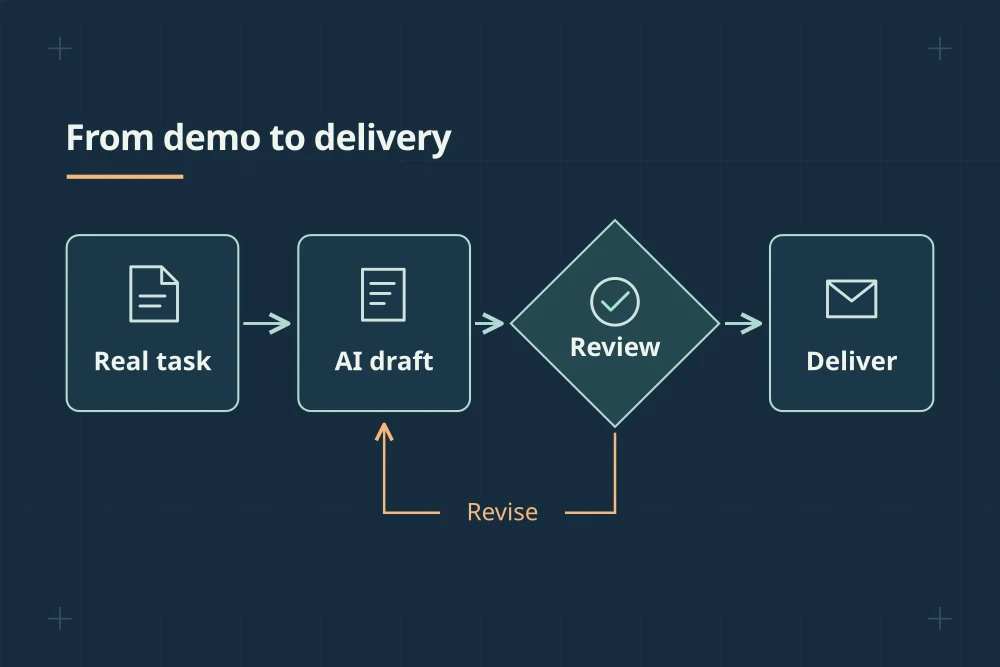
Imagine a service that helps a small manufacturer prepare an application to sell through a retailer. This is a hypothetical example. The customer sends product details, photos and prices, and you turn them into a finished application pack with AI helping to organize and draft it.
It sounds straightforward. But the photos might have confusing file names, last year's prices might be mixed in with the new ones, or the retailer might ask for a different format. Somebody still has to sort that out.
As you work through a sample job, record the software and storage costs, payment fees, and time spent at each stage. Include collecting missing details, checking the result, explaining it, answering questions and making revisions. If you have to refund a job or do it again, count that too.
Keep the costs of individual jobs separate from regular monthly expenses such as bookkeeping, insurance and your basic software subscriptions. You'll need to cover both, but separating them makes it easier to see which types of work take more than you expected.
Give your own time a value, even before the business pays you a wage. Otherwise, a service can look profitable while relying on hours of unpaid work you won't want to keep doing.
See what happens when the job gets a bit messy
Here are some made-up numbers to show how this works. They aren't suggested prices or expected earnings.
Say you charge $180 for an application pack. Software and payment costs come to $12. Preparing the first version takes thirty minutes, and checking it takes another thirty. If you allow $40 for that hour of your time, you have $128 left before monthly business expenses.
Now the customer needs a forty-five-minute revision, followed by fifteen minutes of questions. That's another $40 of your time, leaving $88. If an unclear instruction means you redo an hour's work, you're down to $48.
You can do the same calculation for your idea with three cases: a straightforward job, a fairly normal messy one, and the sort you'd hesitate to take again. At this stage, rough honest numbers are more useful than a detailed forecast built on guesses.
Look for the things you can change. A better question at the start might prevent an hour of corrections later. A clear description of the included revisions might prevent an awkward conversation about another free round of changes.
Choose a price customers can understand
A flat monthly fee sounds convenient, especially when you're still figuring things out. Just check what happens when a customer uses the service a lot. If each extra document, call or revision costs you more, your busiest account could leave you with very little.
Charging for each use can help, though buyers may worry about an unpredictable bill. A system of credits can be confusing if people can't tell what they'll get for their money. Charging for a result needs a clear definition of that result and enough control over whether it happens.
A September 2026 Open Future Forum report describes several pricing approaches used by AI founders. Its responses came from a selected founder and event network, rather than a representative sample of startups. The September refresh included July pricing responses and no new August pricing question. It's useful for seeing the options people are trying, but it doesn't prove which works best. [2]
For a first offer, you could keep things simple: a set amount of work, an expected delivery time and a stated number of revisions. Explain what an extra job or additional change would cost before someone needs one.
Some customers will need more help getting started
One customer may send everything in a tidy folder. Another may need you to work out what's missing and chase three people for it. If your price assumes tidy inputs, that second job will be harder to make worthwhile.
You could offer a standard price when the required information is ready, with a separate preparation service for customers who need help organizing it. A few questions before taking payment can tell you which kind of job you're being asked to do.
Be willing to decline work you can't deliver reliably at the agreed price. Taking every enquiry can leave you doing a different kind of business from the one you meant to start.
Ask yourself what needs to be true for the price to work. Then check whether real customers can reasonably meet those conditions. If most can't, you'll probably need to change the service or the price.
Count the time it takes to find a buyer
There may be decent money left from a job once you've delivered it. But how much work did it take to win that customer? Four calls, a custom sample and a week of follow-up can change the picture.
Track sales time separately so you can see both parts. Also ask why the customer would buy again. A one-off application or event might be a perfectly reasonable service, but putting it on a monthly subscription doesn't give people a new need every month.
Referrals can help you find customers. They still take effort to earn and handle, so be careful about assuming they'll always bring in enough work for free.
Before building much more, try several realistic jobs, including an awkward one, using whatever mix of tools and manual work you need. Time the whole process. Then improve one part and try again.
You'll start to see which promises you can afford to make, which customers are a good fit, and where automation actually saves you effort. That gives you something much firmer to base your price on than the cost of a few subscriptions.
Sources and a few notes
We checked these sources on . The examples and suggested steps are our own unless we say otherwise.
- September 2026 Ramp AI Index: Cracks in the AI Thesis Part 2 (opens in a new tab)
Ramp Economics Lab ·
Business spending and pricing observations from Ramp's data. Not a universal cost benchmark.
- YC Founder AI Report, September 2026 (opens in a new tab)
Open Future Forum ·
Selected event-network responses. September refresh includes July pricing responses and no new August pricing question. Independent of Y Combinator.